What are plastics
Definition
Plastics are a group of synthetic or semi-synthetic materials, the main component of which is a polymer.
A polymer is made by many repeating units - monomers. During a chemical reaction, monomer molecules combine to form a polymer chain. The process of converting a monomer into a polymer is called polymerization.
Polymerization
There are many forms of polymerization. The two main reaction mechanisms by which monomers can be joined together are step-growth and chain-growth polymerization.
A form of step-growth polymerization is a condensation polymerization, in which monomers react with each other to form larger structural units while releasing smaller molecules as a by-products such as water or methanol. 1
Some synthetic condensation polymers include nylon, polyester, polycarbonates, polyurethanes, epoxies. Condensation polymers may be both thermoplastics or thermosetting plastics. Thermoplastic is material made up of polymer resins that become soft when it is heated and become hard when it is cooled. These materials have low melting points and low tensile strength, are easily recycled and do not show any chemical property changes when they are heated or cooled multiple times. When thermoplastics are heated, their physical property changes and they become a homogenized liquid and can be reshaped and resized.
Thermosetting plastics, on the other hand, are resistant to higher temperatures than thermoplastics, and have higher mechanical and physical strength. However, it provides poor elasticity or elongation of the material—once hardened, a thermoset resin cannot be reheated and melted to be shaped differently. 2
In addition polymerization - a form of chain-growth reaction, monomers join by adding on to the end of the chain to form a polymer without the formation of by-products. Addition polymerizations usually are carried out in the presence of catalysts, which in certain cases exert control over structural details that have important effects on the properties of the polymer.
These polymers are often thermoplastic. Some examples are polyethylene, polyvinyl chloride (PVC), acrylics, polystyrene, and polyoxymethylene (acetal). 3
Different types of plastic
Some most commonly used plastics are:
- Acrylic glass or Polymethyl Methacrylate (PMMA)
- Polycarbonate (PC)
- Polyethylene (PE)
- Low-Density Polyethylene (LDPE)
- Medium-Density Polyethylene (MDPE)
- High-Density Polyethylene (HDPE)
- Polypropylene (PP)
- Polyethylene Terephthalate (PETE / PET)
- Polyvinyl Chloride (PVC)
Acrylic is a transparent thermoplastic used as a lightweight, shatter-resistant alternative to glass. The transparent plastic can be made colored and fluorescent, abrasion-resistant, bullet-resistant, UV-tolerant, non-glare, anti-static. Acrylic is seventeen times more impact resistant than glass, easier to handle and process.
Polycarbonates are strong, stiff, hard, tough, transparent engineering thermoplastics that can maintain rigidity up to 140°C and toughness down to -20°C or special grades even lower. The material is amorphous (thereby displaying excellent mechanical properties and high dimensional stability), is thermally resistant up to 135°C and rated as slow burning.
The most common plastic on earth, polyethylene can be manufactured in varying densities. Each different density of polyethylene gives the final plastic unique physical properties. As a result, polyethylene is in a wide variety of products.
Most common polyethylene densities are:
This density of polyethylene is ductile and used to make products like shopping bags, plastic bags, clear food containers, disposable packaging, etc.
Possessing more polymer chains and, thus, greater density, MDPE is typically in gas pipes, shrink film, carrier bags, screw closures, and more.
More rigid than both LDPE and MDPE, HDPE plastic sheeting is in products such as plastic bottles, piping for water and sewer, snowboards, boats, and folding chairs.
This plastic material is a thermoplastic polymer and the world’s second-most widely produced synthetic plastic. Its widespread use and popularity are undoubted because polypropylene is one of the most flexible thermoplastics on the planet. Although PP is stronger than PE, it still retains flexibility. It will not crack under repeated stress. Durable, flexible, heat resistant, acid resistance, and cheap, polypropylene sheets are used to make laboratory equipment, automotive parts, medical devices, and food containers.
The most common thermoplastic resin of the polyester family, PET is the fourth-most produced synthetic plastic. Polyethylene Terephthalate has excellent chemical resistance to organic materials and water and is easily recyclable. It is practically shatterproof and possesses an impressive high strength to weight ratio. This plastic material is in fibers for clothing, containers for foods and liquid, glass fiber for engineering resins, carbon nanotubes, and many other products that we use on a daily basis.
The third-most produced synthetic plastic polymer, PVC can be manufactured to possess rigid or flexible properties. It is well-known for its ability to blend with other materials. The rigid form of PVC is commonly in construction materials, doors, windows, bottles, non-food packaging, and more. With the addition of plasticizers such as phthalates, the softer and more flexible form of PVC is in plumbing products, electrical cable insulation, clothing, medical tubing, and other similar products.4
Resin identification codes
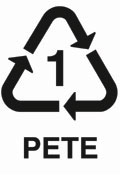
Identification number: 1
Abbreviation: PETE / PET
Polymer name: Polyethylene Terephthalate
Recycling: PET/PETE products CAN be recycled
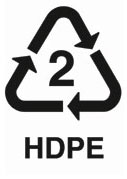
Identification number: 2
Abbreviation: HDPE / PE-HD
Polymer name: High-Density Polyethylene
Recycling: HDPE products CAN be recycled
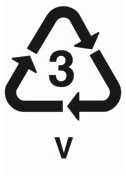
Identification number: 3
Abbreviation: PVC / V
Polymer name: Polyvinyl Chloride
Recycling: PVC products are DIFFICULT to recycle
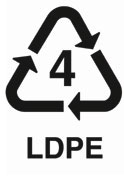
Identification number: 4
Abbreviation: LDPE / PE-LD
Polymer name: Low-Density Polyethylene
Recycling: LDPE products CAN be recycled
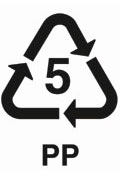
Identification number: 5
Abbreviation: PP
Polymer name: Polypropylene
Recycling: PP products are DIFFICULT to recycle
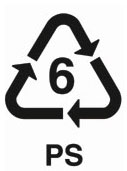
Identification number: 6
Abbreviation: PS
Polymer name: Polystyrene
Recycling: PS products are DIFFICULT to recycle
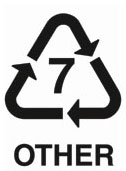
Identification number: 7
Abbreviation: OTHER / O
Polymer name: Other plastics and multilayer combinations of different plastics
Recycling: Products marked with a 7 CAN SOMETIMES be recycled